Pretty New Marketplace

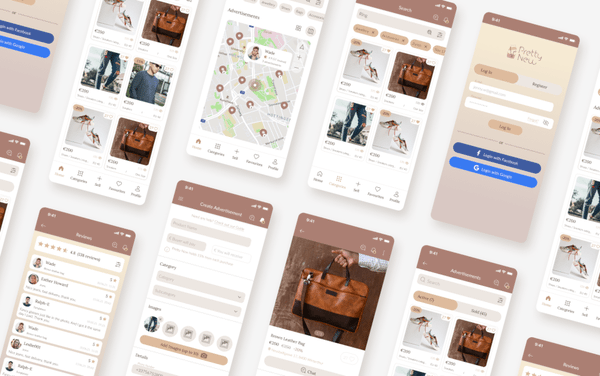
Pretty New is a secondhand-clothing marketplace app for the Swiss market — a country with both German- and French-speaking regions, which turned out to matter more than it sounds like it should.
Customer
A Swiss secondhand-fashion company wanted its own mobile marketplace instead of relying on generic classifieds platforms — buyers and sellers browsing, listing, messaging, and paying inside one app built around their specific market.
Our task
CimpleO delivered the project end to end: UX research and screen design from a blank page, the React Native app for iOS and Android, the Node.js backend, and a custom admin panel — then hardened all of it against the platform-specific bugs that only show up once real devices get involved.
Design process
From wireframe to a 30-screen app
Design started with wireframes, went through a round of concept edits with the client, and only then turned into full visual design — 30 screens built out from the concept the client picked. That sequencing mattered: cheap iteration happens at the wireframe stage, not after 30 screens are already fully designed.
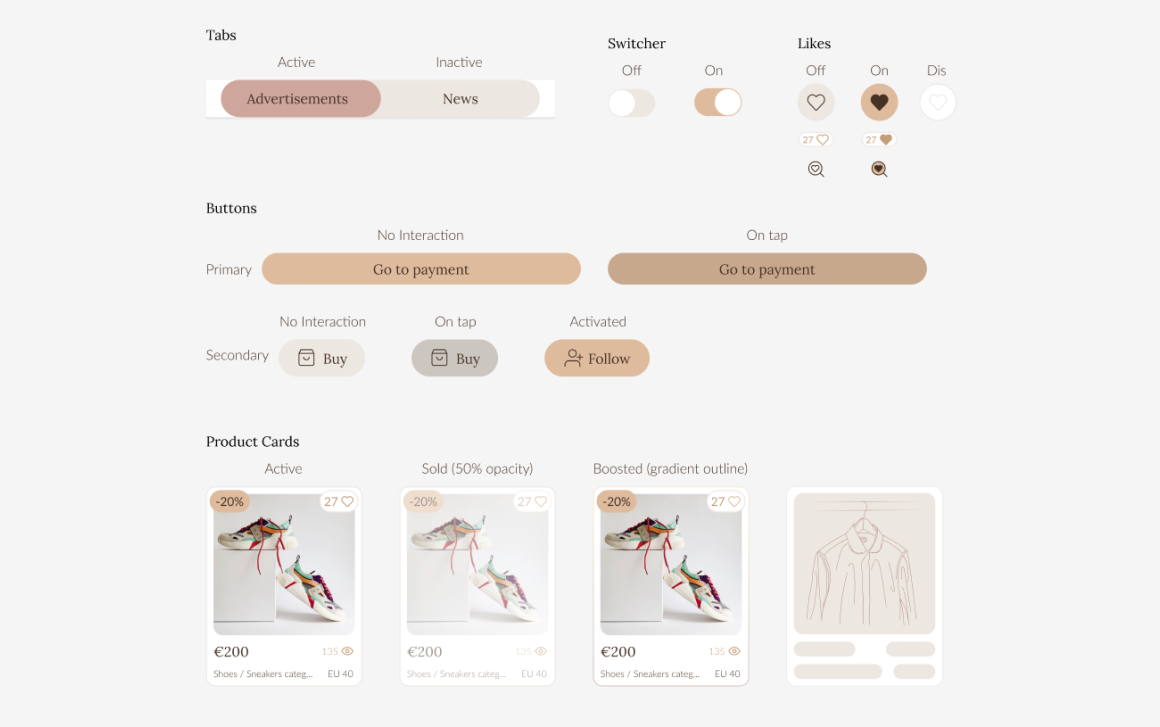
The design system underneath those 30 screens is what makes the app read as one product instead of 30 separate ones — shared button and card states (active, sold, boosted), a consistent like/follow interaction pattern, and one visual language across advertisements and news content.
What we built
The build shipped in four milestones, front end and back end tracked in parallel: accounts and listings first, then map and discovery, then deals and messaging, then monetization and admin tooling.
Listings, search, and categories
Sellers list items into categories (clothes, shoes, bags, jewelry, accessories), each with condition, size, and material composition. Search runs across all of it — including, after a fix, correctly matching German (ä, ö, ü, ß) and French (é, è, à, ç, and others) accented characters as their unaccented equivalents, rather than treating them as different letters entirely. In a bilingual market, that’s not a cosmetic bug; it’s the difference between a search working and silently returning nothing.
Location and meeting up
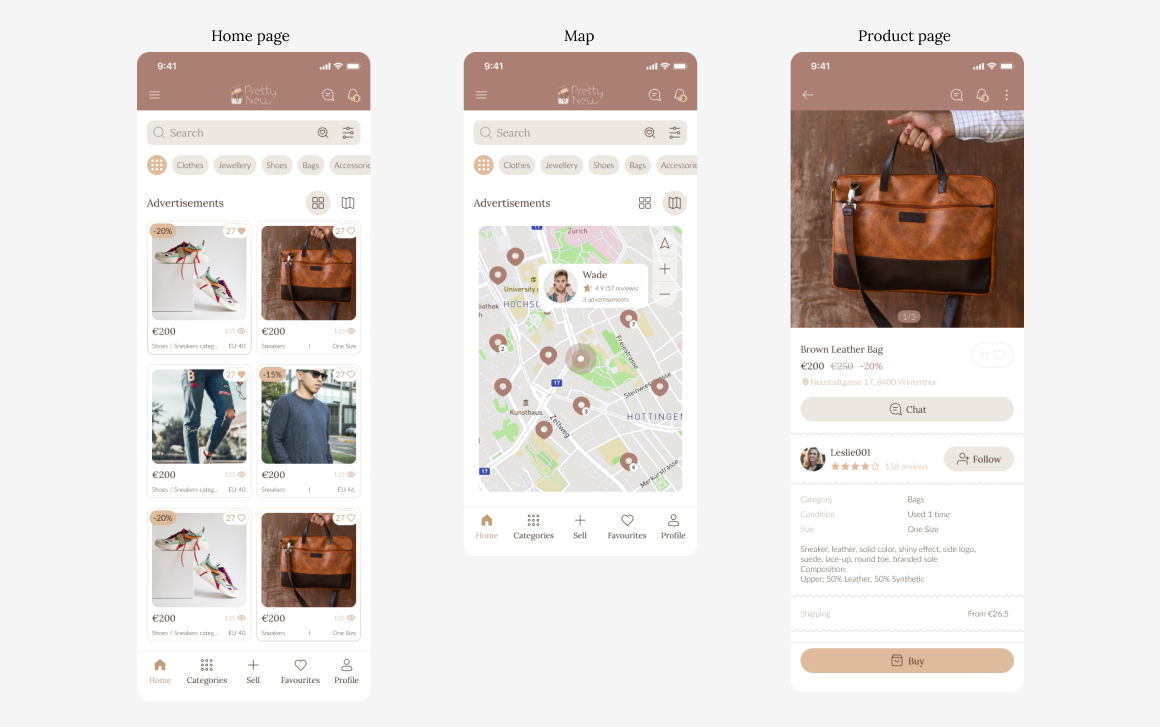
The map is wired into the app more deeply than a single tab — it’s reachable from the home feed, a product page, the create/edit-ad flow, and the user profile, always centered on nearby sellers rather than a generic city view. Deals carry their own meeting-location field for buyer and seller to agree on a handoff point, coordinated through the in-app chat rather than over a phone number neither side wants to share.
Chat with built-in price negotiation
Every listing opens straight into a chat with the seller, and that chat is where price negotiation happens — not as a separate feature bolted on top, but as part of the same real-time conversation that arranges the meetup. It’s the one piece of the app that has to feel instant, since a slow chat is where a deal quietly dies.
Boosted listings
Sellers can pay to boost a listing — visually distinct in the app (a gradient outline on the product card, visible in the design system above) and prioritized in search and the home feed. It’s the marketplace’s answer to the oldest problem in any listings app: how a good item doesn’t get buried under newer ones.
Payments and the marketplace’s cut
Checkout runs through Stripe and MangoPay, split across a buyer-facing payment step and the marketplace-side payout logic a peer-to-peer marketplace needs — Pretty New takes a percentage of each completed deal, calculated and displayed to the seller at the point of listing, not as a surprise at payout.
Admin panel
A separate web dashboard gives the Pretty New team table- and card-based views over users, listings, and deals — built from scratch alongside the app rather than adapted from an existing tool, so it matches the same data model the mobile app runs on.
Hardening for iOS
A dedicated pass caught the class of bugs that only exist on one platform: layout that ignored the notch on newer iPhones and let system status icons overlap the header, a registration screen that didn’t scroll far enough to keep its submit button above the keyboard, and an SMS-resend countdown during phone verification that displayed the wrong count. None of these show up in a simulator running the common case — they show up when a real customer hits the actual edge.
Deployment
The app shipped to both the Apple App Store and Google Play, with the account, listing, and store-configuration work each platform requires handled as part of delivery — not left as a follow-up task after “the code is done.”
Results
Pretty New gives its market a marketplace built around how they actually search, negotiate, and meet up to complete a deal — bilingual search that works, chat that doubles as a negotiation tool, and a boost mechanism and commission model that keep the marketplace itself sustainable, not just the transactions passing through it.