RAG vs Fine-Tuning: Which One Actually Solves Your Problem
Reading time: 7 minutes
Last modified:
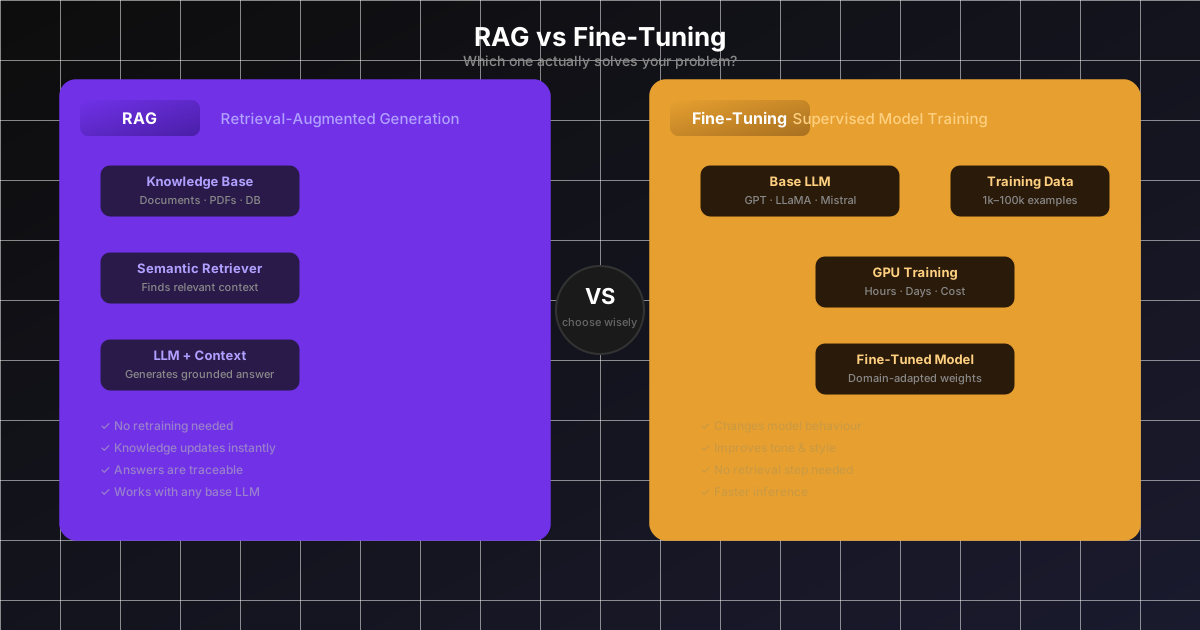
Every team building an LLM product hits this fork in the road: should we retrieve relevant information at runtime, or should we train the model to know it already? The question sounds technical. The answer is mostly practical — and most teams get it wrong by defaulting to fine-tuning when retrieval would have done the job in a fraction of the time and cost.
This post breaks down both approaches honestly, shows you when each one wins, and gives you a decision framework you can use today.
What RAG Actually Is
RAG — Retrieval-Augmented Generation — doesn’t change the model. It changes what the model sees when it generates a response.
At runtime, when a user asks a question, the system first searches a knowledge base for the most relevant chunks of text (using vector similarity search), then injects those chunks into the prompt as context. The LLM reads both the retrieved context and the question, and generates an answer grounded in what it just read.
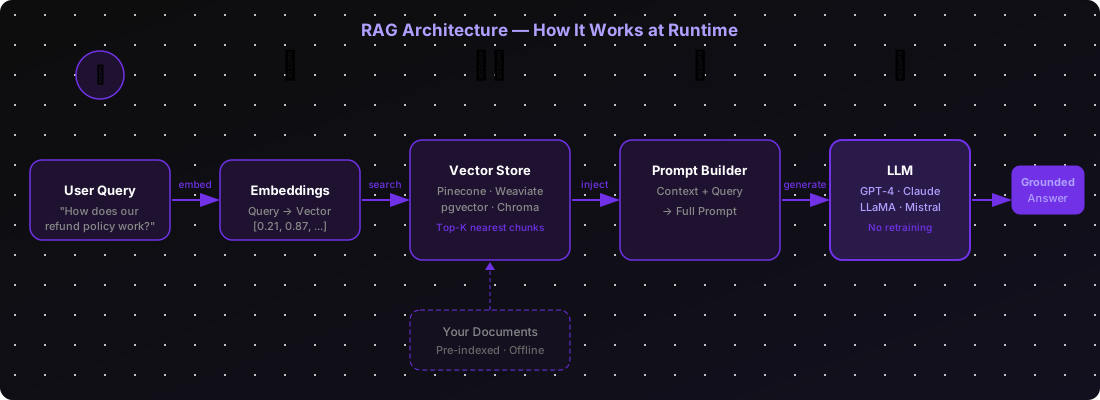
The model itself — GPT-4, Claude, LLaMA, whatever you’re using — is never touched. You can swap the underlying model out entirely without rebuilding your knowledge pipeline. The knowledge lives in your document store, not in the model’s weights.
What RAG is good at:
- Answering questions from a specific corpus (product docs, legal contracts, internal policies, support history)
- Keeping knowledge current — update the document store, the answers update automatically
- Providing traceable, citeable answers (you know exactly which source the model used)
- Working with private data that can’t be included in public model training
What RAG is not:
- A way to change how the model reasons, writes, or behaves
- A solution for tasks where no relevant document exists to retrieve
- A replacement for structured databases when you need exact, reliable data retrieval
What Fine-Tuning Actually Is
Fine-tuning continues training a pre-trained model on your own dataset. You’re adjusting the model’s weights so it learns patterns, behaviours, or knowledge that the base model doesn’t have.
This takes GPU time (hours to days depending on model size and dataset), a labelled training dataset (typically 1,000–100,000 examples), and careful evaluation to avoid degrading the model’s general capabilities while improving its domain-specific performance.
What fine-tuning is good at:
- Changing the model’s output style — more concise, more formal, structured output formats (always respond as JSON, always follow a specific template)
- Teaching a specific task the base model handles poorly — medical coding, legal clause extraction, niche classification tasks
- Removing capabilities you don’t want — a customer service bot that stays strictly on-topic
- Reducing prompt size — once the model knows your format well, you don’t need to re-explain it every time
What fine-tuning is not:
- A way to inject new knowledge. A model fine-tuned on last year’s product catalogue will not know about this year’s products unless you retrain it. Fine-tuning teaches how to respond, not what is currently true.
- A one-time project. As your product or domain evolves, the model needs to be retrained. This has ongoing cost and maintenance implications.
- A substitute for RAG when the real problem is knowledge access.
The Core Difference, in Plain Terms
| RAG | Fine-Tuning | |
|---|---|---|
| What changes | The context provided at runtime | The model’s weights |
| Knowledge updates | Instant (update the doc store) | Requires retraining |
| Cost | Inference cost + vector search | GPU training + inference |
| Use when | You need specific facts | You need different behaviour |
| Answers are traceable | Yes — to source chunks | No |
| Data privacy | Private docs, never leave your infra | Training data exposure risk |
The mistake most teams make: they see that the model gives wrong answers about their product, and they conclude the model “doesn’t know enough.” So they fine-tune it. But the model wasn’t wrong because of missing knowledge — it was wrong because it had no access to the right source. Fine-tuning doesn’t fix that. The next time a product detail changes, it’s wrong again.
RAG fixes the access problem. Fine-tuning fixes the behaviour problem.
When RAG Wins
Internal knowledge assistants. A support team that needs to query 10,000 support tickets, three policy documents, and six product manuals simultaneously. The knowledge is too large to fit in context. RAG retrieves the three most relevant chunks and the model answers accurately.
Frequently changing information. Pricing, product specs, regulations, case law. Anything that changes more often than you want to retrain a model. Update the document store and the answers are immediately current.
Private or sensitive data. Patient records, legal documents, financial data. You can run RAG entirely within your own infrastructure — the data never touches a cloud training pipeline.
Customer-facing Q&A on a large catalogue. eCommerce, SaaS support, internal HR portals. The model doesn’t need to be smart differently — it just needs access to the right documents.
When Fine-Tuning Wins
Consistent structured output. If every response needs to follow a specific JSON schema, a specific report format, or a clinical note template, fine-tuning teaches the model to produce that format reliably — so you don’t need to engineer a ten-line format instruction into every prompt.
Domain-specific reasoning. A model that needs to interpret radiology reports, classify insurance claims, or write legally precise contract clauses benefits from fine-tuning on high-quality domain examples. The model learns the vocabulary and reasoning patterns of the domain.
Reducing hallucinations on a specific narrow task. Fine-tuning on carefully curated examples of correct outputs for a well-defined task produces more reliable results than prompting alone.
Replacing a large prompt with learned behaviour. If you have a 2,000-token system prompt explaining how the model should behave, and you’re making thousands of API calls per day, fine-tuning that behaviour into the model reduces cost and latency significantly.
The Decision Framework
Use this to decide in under five minutes:
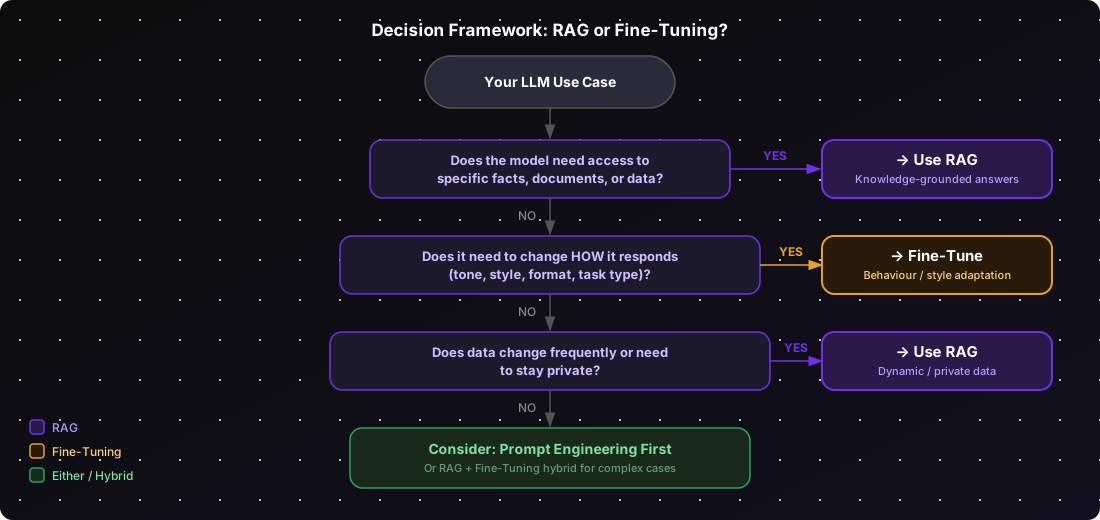
- Does the model need access to specific facts, documents, or data? → Start with RAG.
- Does it need to change how it responds — tone, style, format, task type? → Fine-tuning is worth evaluating.
- Does the data change frequently or need to stay private? → RAG, regardless of what else you need.
- Neither? → Try prompt engineering first. It’s free and often sufficient.
For complex production systems — enterprise knowledge bases, multi-domain assistants, high-accuracy professional tools — the answer is usually both: a fine-tuned model that behaves correctly for your domain, with RAG providing current, authoritative context at inference time. But get RAG working first. Fine-tune later if the behaviour still isn’t right.
The Hybrid Approach
The most capable production LLM systems combine both:
- Fine-tune the base model on domain-specific examples to get the output format, reasoning style, and task focus right.
- Add RAG to provide current, specific knowledge at inference time.
This is how enterprise AI assistants are typically built when both accuracy and behaviour matter. The fine-tuned model knows how to answer. RAG provides what to answer from.
Start with RAG + a strong base model. If the behaviour (format, style, task focus) is still wrong after good prompting, add fine-tuning. In the majority of business use cases, you’ll get 90% of the way there with RAG alone.
What to Avoid
Fine-tuning as the first response to “wrong answers.” Diagnose the problem first. Wrong answers usually mean missing context (RAG problem) or poor reasoning (prompting or fine-tuning problem). They are different problems with different solutions.
RAG as a replacement for data quality. If your documents are poorly written, contradictory, or out of date, RAG will retrieve bad context and the model will produce bad answers. Garbage in, garbage out — the model is not at fault.
Assuming fine-tuning is a one-time cost. It isn’t. Every time your domain, product, or requirements evolve, you’re back in the training loop.
Building an LLM feature and not sure which approach fits your use case? Write to us at hello@cimpleo.com — we’ll tell you what we’d recommend and what it would take to build it.