The Hidden Costs of Offshore Development (And How to Avoid Them)
Reading time: 6 minutes
Last modified:
The spreadsheet makes it look easy. Senior developer, $35/hour, 8 hours/day, 20 days/month. That’s $5,600 a month. Versus the same person in-house at $12,000 to $15,000. The math is obvious and the decision feels straightforward.
Then six months go by and the total doesn’t look like the spreadsheet.
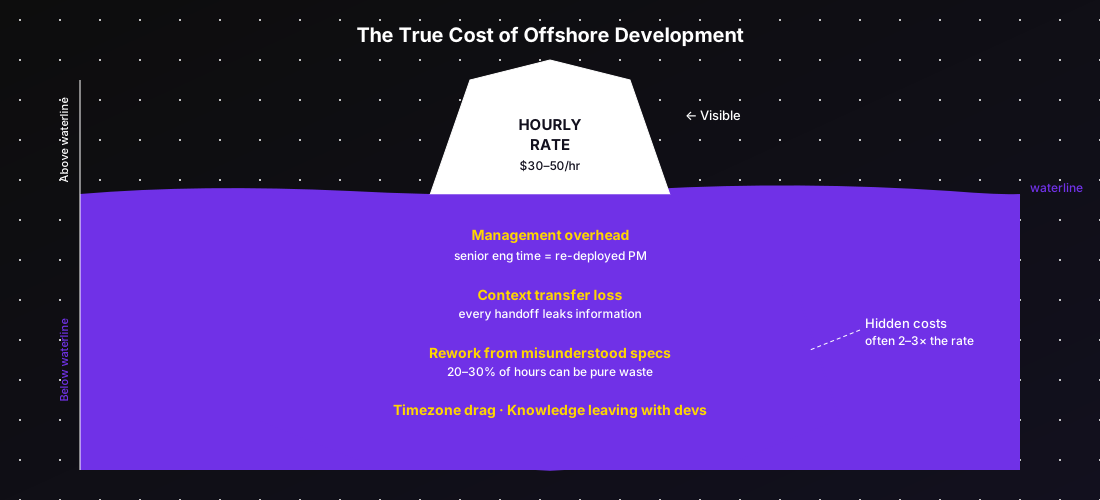
This post isn’t an argument against offshore development. Done right, it works. The point is that the hourly rate is the smallest number in the equation. Every company that’s done this at scale has learned — expensively — that the visible cost is the tip of the iceberg.
Hidden Cost 1: Management Overhead
The most consistent hidden cost in offshore development is the management burden it creates on your own team.
Someone experienced on your side needs to translate business requirements into technical specifications, answer questions, review pull requests, unblock decisions, and manage the relationship. In practice, this is a near-full-time role for a senior engineer or tech lead. That person is no longer shipping features.
If your offshore engagement is 3 developers at $35/hour, and managing them consumes 60% of a $120,000/year tech lead’s time, you’ve already added $72,000 to the effective cost of those three developers. That changes the maths significantly.
Offshore development doesn’t reduce the management work. It moves it — and usually makes it harder, because now it’s cross-cultural, asynchronous, and over a communication channel rather than a hallway conversation.
Hidden Cost 2: Context Transfer Time
Every handoff between the team that understands the business and the team doing the implementation leaks information.
A developer who’s been embedded in your product for 18 months understands the implicit constraints — the technical debt in module X, the reason we don’t touch function Y, the business logic buried in a comment written two years ago. An offshore developer doesn’t have any of that context.
Building that context takes time — typically 6–12 weeks before an offshore developer is contributing at full velocity. On a short engagement, you might never reach full velocity. On a longer engagement, you pay the ramp-up cost every time a developer cycles off the project.
More insidiously: context transfer is never complete. The things you don’t know you need to explain don’t get explained. Those become bugs.
Hidden Cost 3: Rework from Misunderstood Requirements
The further a developer is from the business, the more likely a specification is to be misinterpreted. Not because offshore developers are less capable — because distance, language, and async communication all increase the probability that the requirement that was written and the requirement that was understood are different.
A misunderstood requirement discovered on day 2 costs an hour to fix. The same misunderstanding discovered at code review costs a day. Discovered in QA costs a week. Discovered in production costs significantly more.
In offshore engagements with poor spec quality and slow feedback cycles, rework rates of 20–30% are common. That’s 20–30% of your developer hours delivering no output. The hourly rate on those hours is 100% waste.
Hidden Cost 4: Timezone Drag on Decisions
A 6–9 hour timezone gap means that a blocker raised at end of business in Eastern Europe or Southeast Asia won’t get answered until the following morning at best. That’s one lost working day per question.
In a fast-moving product environment, developers hit multiple blockers per day. Some they can work around. Others require a decision from the business or from your lead engineer. Each one that waits 24 hours slows the cycle.
The effect is that offshore teams that look like they have 8-hour days are often operating effectively for 4–5 hours, because the morning is spent waiting for responses to yesterday’s questions. Sprint velocity suffers in ways that don’t show up on the hourly rate.
Hidden Cost 5: Knowledge That Leaves When the Contract Ends
At the end of an offshore contract, the developers take their understanding of your codebase with them. If you haven’t invested in documentation, code comments, architecture decision records, and handover processes, you’re starting from scratch with the next team.
This is the most insidious hidden cost because it compounds over time. Every rotation of offshore developers means another ramp-up period, another context transfer loss, another wave of tickets that need to be answered by whoever on your side has institutional memory.
Some companies have run offshore contracts for years and found themselves with code that nobody — internally or externally — fully understands. That’s a technical debt problem with a talent dimension attached to it.
What Good Offshore Engagement Looks Like
The offshore model that works looks different from the model most companies sign up for.
Dedicated team, not staff augmentation. A team assigned to your product long-term, who build context over time, is categorically different from a pool of hours you draw on as needed. The former builds knowledge. The latter rents hands.
Overlapping working hours. Requiring 4 hours of real-time overlap with your core team isn’t a nice-to-have — it eliminates the 24-hour decision lag that kills velocity. Build this into the contract.
Embedded product context. Offshore developers who attend product meetings, understand the business goals behind features, and have access to the same documentation as your in-house team make fewer wrong assumptions. This requires investment on your side, but it pays back through lower rework rates.
Handover as a continuous process. Documentation, ADRs, code comments, recorded demos — not a one-week sprint at the end of the contract. Knowledge should accumulate throughout the engagement, not evaporate at the end.
Questions to Ask Before Signing
- Who on our side is responsible for this engagement, and what percentage of their time does that represent?
- What does the team rotation policy look like? How often do developers cycle off?
- What timezone overlap will we have, and is it contractually guaranteed?
- How do you handle knowledge transfer when the engagement ends?
- Can we see examples of documentation produced in previous engagements?
- What’s the escalation path when a decision is needed and it’s outside business hours?
If the answers are vague, the contract probably doesn’t protect you from the costs described above.
When Offshore Makes Economic Sense
| Scenario | Offshore works | Offshore doesn’t work |
|---|---|---|
| Team size | 4+ dedicated developers | 1–2 ad hoc contributors |
| Engagement length | 12+ months | Short-term projects |
| Spec quality | Detailed, reviewed specs | Loose requirements |
| Internal management | Dedicated tech lead | Stretched eng team |
| Timezone overlap | 4+ hours guaranteed | Async only |
| Knowledge continuity | Low developer rotation | Frequent team changes |
Offshore development makes the most economic sense when you need to scale a team faster than the local talent market allows, at a price point that isn’t viable domestically, and you have the internal infrastructure to manage it properly. That last condition is the one most companies underinvest in.
If you don’t have the management capacity, the spec quality, or the overlapping hours, the model costs more than it saves.
Evaluating offshore development options or trying to diagnose why an existing offshore engagement isn’t delivering? Write to us at hello@cimpleo.com — we’ve structured these engagements from both sides and can help you figure out what’s actually going wrong.