Why Custom eCommerce Outperforms Off-the-Shelf Platforms at Scale
Reading time: 6 minutes
Last modified:
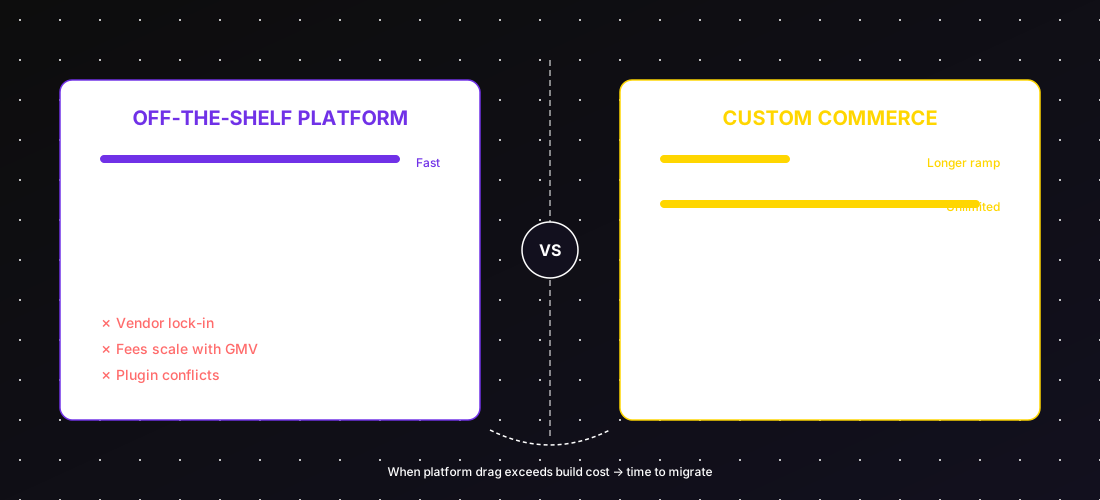
Shopify is a good product. WooCommerce is a reasonable choice. BigCommerce, Magento hosted edition, Wix — they all exist because they solve a real problem for a real segment of the market. If you’re launching a new store, picking one of these platforms is probably the right call.
The mistake isn’t using them. The mistake is staying on them too long.
At some point — and there’s a fairly predictable set of signals for when that point arrives — the platform you chose to move fast starts slowing you down. What was leverage becomes drag. This post is about identifying that point before it’s costing you more than you think.
The Sensible Starting Point
Off-the-shelf platforms give you payment processing, inventory management, hosting, a checkout flow, and a plugin ecosystem — out of the box, on day one. For a business that hasn’t proven product-market fit, that’s the correct trade: accept constraints on customisation in exchange for speed to market and low operational overhead.
At sub-$1M GMV, most businesses don’t have problems that a platform can’t solve. They have bigger problems — customer acquisition, product selection, operations. Spending engineering budget on a custom checkout at this stage is a distraction.
The platform is doing its job. Let it.
The Inflection Point
The inflection point isn’t a revenue number. It’s when the gap between what you need the platform to do and what it actually does starts consuming real resources.
That happens gradually, then suddenly. You hire a developer to work around a plugin limitation. Then another developer to manage the workarounds. Then a third to maintain the integrations between the workarounds. At some point, your “off-the-shelf” solution has a custom layer on top of it, but none of the advantages of a truly custom system.
5 Signals You’ve Outgrown Your Platform
1. Plugin conflicts are blocking deployments. You need three plugins to cover a feature that should be native. Two of them update independently and break each other. Your developer is spending more time managing dependencies than shipping features. This is a compounding problem — it gets worse with every new capability you need.
2. Checkout can’t be customised enough. Checkout conversion is the most critical metric in eCommerce. Platforms like Shopify Plus give you some customisation at a significant premium, but you’re still operating within constraints you didn’t choose. If your conversion optimisation roadmap is blocked by what the platform allows, that’s a direct revenue limitation.
3. Reporting requires third-party hacks. You’re exporting CSVs into a data warehouse because the platform’s reporting doesn’t give you what you need. You’ve bought a BI tool to compensate. Your analysts are writing SQL against an external database that’s one API version change away from breaking. The data infrastructure you actually need is sitting outside the platform you’re paying to run your business on.
4. Performance is throttled by the platform. Core Web Vitals matter for both SEO and conversion. On hosted platforms, you don’t control the server stack, the CDN configuration, or the rendering pipeline. You can optimise images and minify scripts, but you’re working within a ceiling you didn’t set. For high-traffic stores, that ceiling is real and measurable.
5. Vendor lock-in is costing real money. Transaction fees on top of payment processor fees. Forced app subscriptions to access APIs. Platform charges that scale with revenue regardless of infrastructure costs. At a certain GMV, the platform’s cost structure no longer makes sense. You’re paying for the platform’s R&D and sales, not for infrastructure you actually use.
What Custom Development Actually Means
Custom eCommerce doesn’t mean building a payment gateway from scratch. That would be insane. It means composable commerce: assembling best-in-class commodity components — Stripe or Adyen for payments, Algolia for search, a headless CMS for content, a purpose-built OMS for fulfilment — and building the logic layer yourself.
The checkout is yours. The data model is yours. The integration architecture is yours. You’re not fighting the platform’s assumptions; you’re implementing your own.
Headless commerce — where the frontend (React, Next.js) is completely decoupled from the backend commerce logic — is the most common pattern at this tier. You keep the frontend team moving without waiting for backend limitations, and you can swap components independently without rebuilding everything.
The Total Cost Comparison
| Platform + Plugins | Custom | |
|---|---|---|
| Initial build cost | Low | High |
| Ongoing platform fees | $500–$5,000+/month | Hosting only |
| Developer overhead | Workarounds, upgrades | Feature work |
| Customisation ceiling | Platform-defined | None |
| Data ownership | Platform holds your data | You own everything |
| Scaling cost | Fees scale with GMV | Infrastructure scales with load |
At $5M GMV, the maths often starts to flip. At $10M GMV, the cost of staying on a platform frequently exceeds the amortised cost of a custom build within 18–24 months. This is a calculation worth doing explicitly.
The Migration Path
The single biggest concern with going custom is the migration itself. The answer isn’t a big-bang cutover — it’s a phased transition.
Start with the parts where you’re most constrained: typically checkout and reporting. Build those custom, route traffic there, keep the platform running for everything else. Once the custom systems are proven, migrate the catalogue, then inventory, then customer accounts. Run parallel for as long as you need.
You don’t go dark. You incrementally retire the platform over 3–6 months.
The technical prerequisites: a proper API layer on your custom backend, a data migration plan that accounts for order history, customer accounts, and SEO URLs, and a rollback path for each phase.
Who Should Not Go Custom
Not every business at scale needs a custom platform. Be honest about whether this applies to you:
- Sub-$1M GMV: The economics don’t work. Platform costs are trivial compared to development costs at this stage.
- No dedicated engineering team: Custom commerce requires ongoing engineering investment. A one-time build with no maintenance budget is worse than a platform.
- Catalogue under 500 SKUs with no complex variants: Platforms handle this well. Custom isn’t buying you anything.
- No clear platform limitation causing measurable pain: Don’t build custom because you think you might need it. Build it when you can point to specific revenue impact or developer velocity impact caused by the platform.
The business case for custom should be grounded in specific, measurable costs. If you can’t articulate what the platform is costing you in concrete terms, it’s probably not time yet.
If you’re running into the signals above and trying to figure out whether a custom build makes sense for your business, write to us at hello@cimpleo.com — we’ll walk through the numbers with you and tell you what we’d actually recommend.