Plantone: ESP32 Plant-to-Music Synthesizer

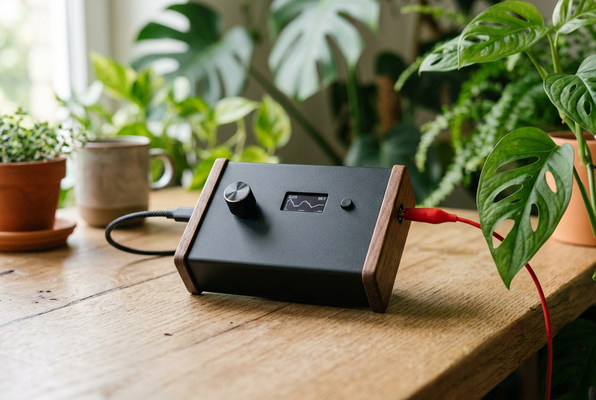
Plants generate small, constantly shifting electrical signals across their leaves. Plantone reads those signals and turns them into sound in real time: an instrument played by a living plant instead of a musician. We built the device from a bare-breadboard signal test through a finished, factory-assembled unit with its own enclosure and controls.
The Challenge
The core problem sat at the boundary between biology and electronics: plant signals are tiny, noisy, and slow compared to audio frequencies. Turning that raw input into music that sounds intentional, not random, meant building a full signal chain (amplification, filtering, a synthesis engine) and fitting all of it onto hardware small enough to sell as a consumer product.
Every choice fed into the next one. A cleaner analog front end simplified the DSP work downstream. A more capable chip freed up options for reverb and multi-channel panning but changed the power and cost budget. We also had to make it playable: octave selection, sensitivity, and reverb needed physical controls a person could operate without a manual.
What We Built
- Signal chain to capture plant electrical activity and convert it into an audio-rate stream
- Hardware synthesizer running on a dedicated DSP chip, later ported to ESP32
- USB MIDI output, prototyped first on an ATtiny85
- Octave selection, sensitivity slider, reverb, and channel panning controls
- Noise reduction across the analog and digital stages
- Onboard display and a save function for stored settings
- Web interface for adjusting common settings without the physical controls
- Encoder knob added for on-device settings navigation
- USB-C connector replacing the original micro-USB
- Enclosure design and internal layout for the first sellable unit
- Final assembly run on a factory-produced PCB
Delivery
The project moved from a breadboard proving the signal-to-audio concept, through a prototype that generated real music from a live plant, to a production-ready device with its own board, enclosure, and factory assembly. Late-stage work focused on the details that separate a working prototype from a shippable product: connector standardization, panel layout, and a settings interface usable without a computer.