
Pomodorix
- For
- People in open-plan offices who need protected focus time.
- Built
- Two-LED firmware and power tests are done; the 12-LED ring firmware runs on the bench.
- Next
- A 12-LED ring board and an enclosure; early testers for the bare board.
- Last activity
- Sep 2021

Open-plan offices break concentration. A Slack message, a tap on the shoulder, a question across the desk — any interruption during a focus window costs real recovery time. Calendar status and headphone lights are too easy to miss or ignore.
Pomodorix is a small physical timer for one desk, not a networked office system. Hold the button to start: a red light means focus, a green light means break, and the device switches between them on its own after a fixed interval — 40 minutes red, 10 minutes green by default. A short press jumps straight to the next state, for cutting a session short or starting the next one early. Holding the button again pauses the whole cycle.
The current hardware is a two-LED prototype built around an ATtiny13 — one of the smallest AVR microcontrollers available, chosen to prove the timer can run for months on a coin cell rather than days. The firmware sleeps the chip between watchdog-timer wake-ups instead of keeping it running continuously, and pulses the LED for a few milliseconds per cycle rather than holding it lit. A dedicated power-consumption test build validated that approach before interrupt-driven button handling — telling a short press from a long one — was added on top.
A second firmware branch already drives the next revision: swap the ATtiny13 for an ATtiny85 (more I/O, enough to run Adafruit’s NeoPixel library) and replace the two status LEDs with a 12-LED ring. The arc grows one LED at a time over the focus or break interval instead of flipping a single light on and off, the ring flashes blue to show how long the button has been held, and three timer presets (roughly 40/20, 45/15, and 50/10 focus/break splits) cycle on a medium-length press. That firmware runs; the board and enclosure to put it in do not exist yet.
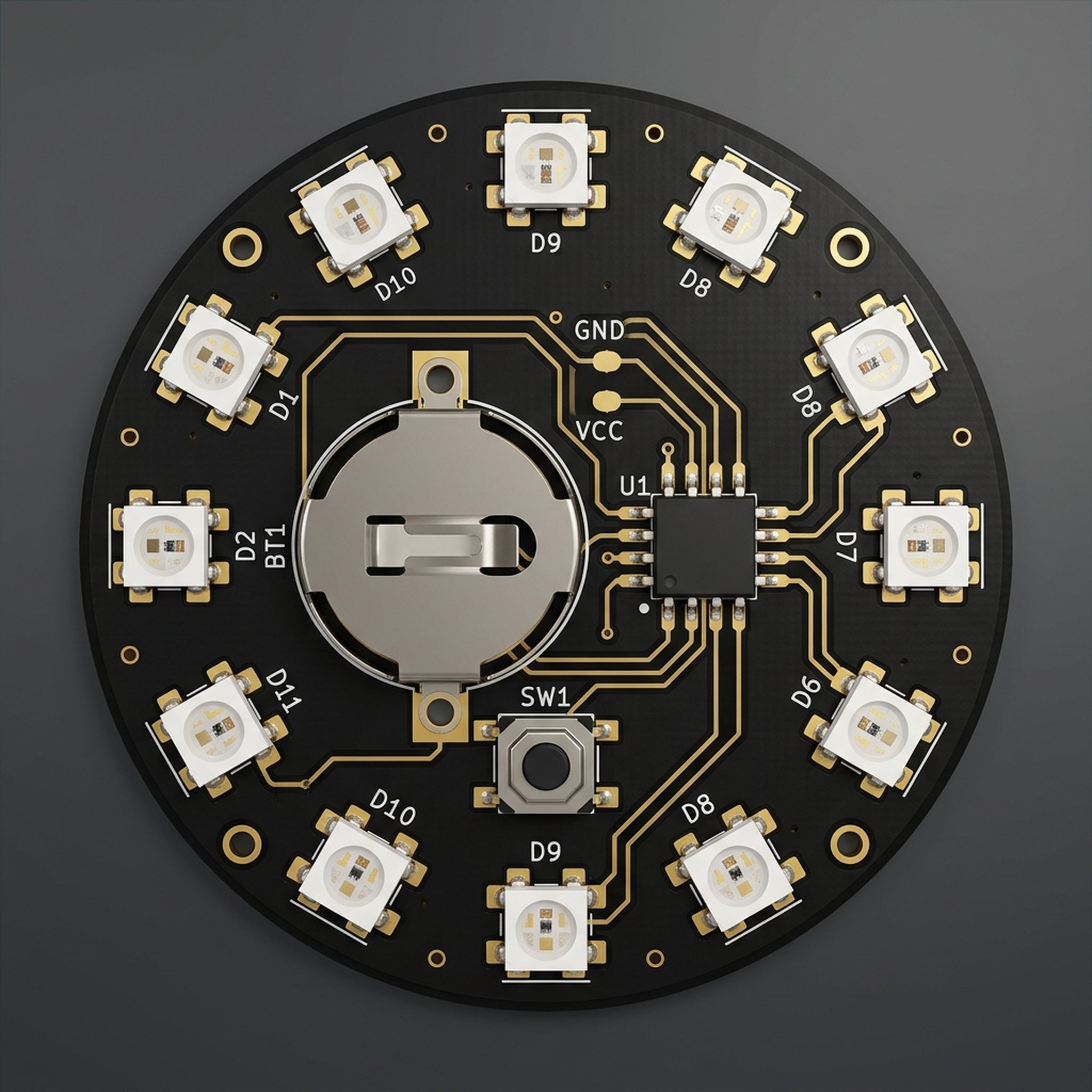
The renders here (including the cover photo above) show where that revision is headed, not what’s on the desk today: a round board with the coin cell and the ATtiny85 in the center, the 12 LEDs ringing the edge, and an enclosure — a matte black puck with the button on top and the LED ring showing through a light pipe at the rim.
Wireless integration — muting notifications, setting a “focusing” status in Slack or Teams — stays a possible later layer, not a current feature. The ATtiny13/85 family has no radio; that means a third chip and another hardware revision, not a firmware update.
Prototype stage: the two-LED firmware and its power-consumption tests are done, the 12-LED ring firmware runs on the bench, no enclosure exists yet. Commercial model candidates once the hardware is finished: direct consumer (bundled with focus/productivity accessories), B2B (corporate office supply channel), and white-label for productivity app vendors wanting a hardware companion.
Engineering at a glance
- Stage: prototype. The two-LED firmware and its power tests are done. The 12-LED ring firmware runs on the bench. No ring board or enclosure exists.
- Effort: about 82 engineering hours, two engineers, June to September 2021. The firmware repository holds 13 commits.
- Chip: ATtiny13 at 1 MHz, flashed through USBasp from PlatformIO (
atmelavr). - Power: watchdog-timer sleep between wake-ups, LED pulses of a few milliseconds, interrupt-driven button handling.
- Next revision: ATtiny85 with a 12-LED NeoPixel ring and three timer presets.
Need a team that ships hardware, firmware and cloud like this? Talk to us.