
hscLink
- For
- Property managers and utility providers.
- Built
- Pulse-counter node, GSM gateway and a billing platform; 1,000+ engineering hours.
- Next
- Pilot deployments in multi-unit buildings.

Wireless meter reading for multi-unit buildings
Multi-unit buildings still meter water, gas, heat, and electricity by hand — a technician walks every unit, writes down numbers, and someone re-types them into a billing spreadsheet weeks later. Errors compound, disputes drag on, and a leak or a stuck meter goes unnoticed until the bill arrives.
hscLink (Home Smart Cloud) replaces the walk-through with wireless metering. A compact LoRa node clips onto a water, gas, heat, or electricity meter and reports consumption over a self-organizing mesh network — no Wi-Fi, no per-unit SIM card, no rewiring. Readings stream in as MQTT telemetry, get checked against the meter’s calibration profile (litres per pulse) and against the previous reading to reject rollback errors, then land in per-account billing reports automatically.
Multi-tenant billing and access control
The platform is multi-tenant by design. A management company owns buildings and sees every meter across its portfolio; a utility provider sees only the buildings it actually supplies; tariffs attach to a resource and, where one exists, an individual subscriber’s rate overrides the building default. The backend is a TypeScript/NestJS API on MySQL, shipped as two Docker services — a subscriber process that ingests MQTT telemetry and a public HTTP API documented via Swagger — both rebuilt and redeployed on push to master.
Access control goes down to the individual action: JWT authentication, bcrypt-hashed passwords, and more than 50 permission-gated endpoints, from address lookup to billing reports, each traceable in a dedicated audit log. Adding a building looks up the official Russian address registry as you type, and a meter that misses its check interval gets flagged as overdue instead of silently reporting nothing. The dashboard itself is an installable Progressive Web App with a live events screen that refreshes every 60 seconds and per-meter consumption charts, not just tables of numbers.
Mesh hardware and gateways
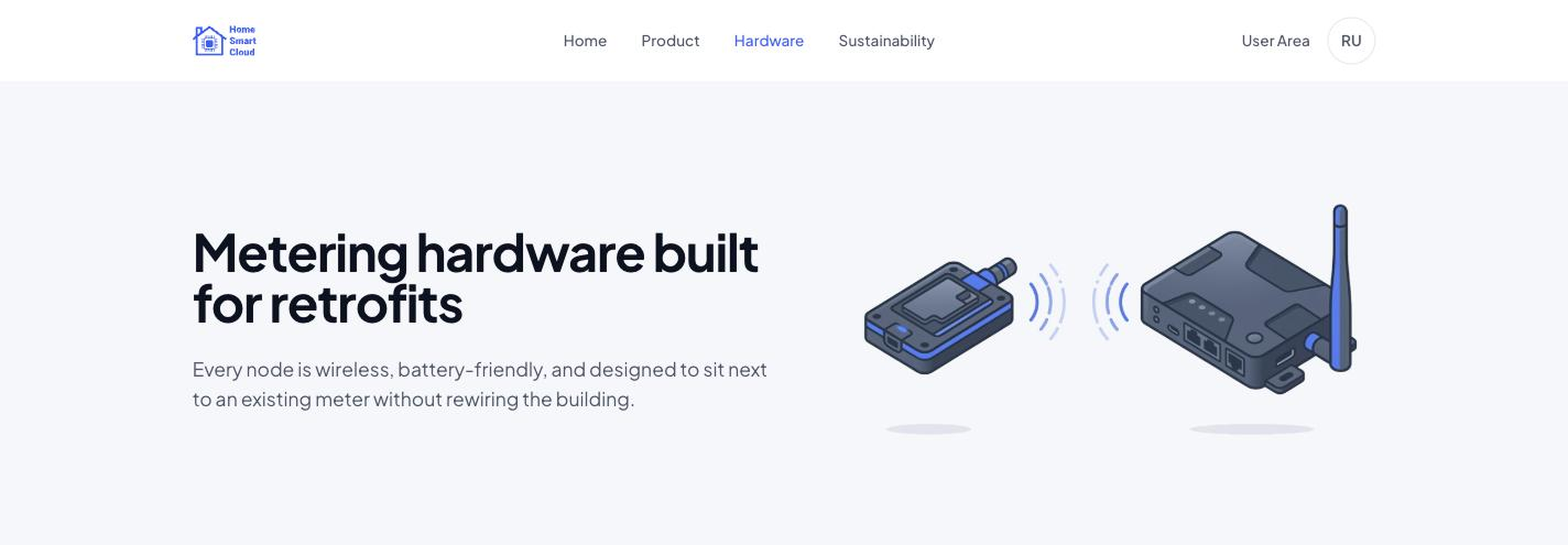
The mesh hardware went through its own prototyping cycle: a LoRa + FreeRTOS firmware build, tested for delivery reliability and stability under continuous operation, then a self-organizing mesh rollout so one gateway covers a whole building without needing line of sight to every node. Each node measures its own battery voltage through a resistor divider that only powers on for the reading and averages 16 samples, so the health check barely touches the power budget it’s protecting. Deployed GSM gateways connect over a commercial carrier APN and publish to versioned MQTT topics, so the wire format can evolve without breaking units already in the field. The gateway queues telemetry on its own Mosquitto MQTT broker and retries automatically if the uplink drops. Home Assistant integrations — smart lighting, humidifiers, motion and relay control — are scoped as the next expansion beyond pure utility metering.
Since the project started in 2020, it has logged well over 1,000 hours of engineering work across firmware, mesh networking, and the billing backend.
Frequently Asked Questions
What does hscLink measure?
Water, gas, heat and electricity consumption. A LoRa node clips onto the meter and reports its readings.
Does it need Wi-Fi or a SIM card in every unit?
No. Nodes form a self-organizing mesh, and one gateway covers a whole building. Readings reach the platform as MQTT telemetry.
Can a utility and a management company use the same deployment?
Yes. A management company sees every meter in its portfolio. A utility provider sees only the buildings it supplies.