How to Choose a Tech Stack for Your MVP
Reading time: 6 minutes
Last modified:
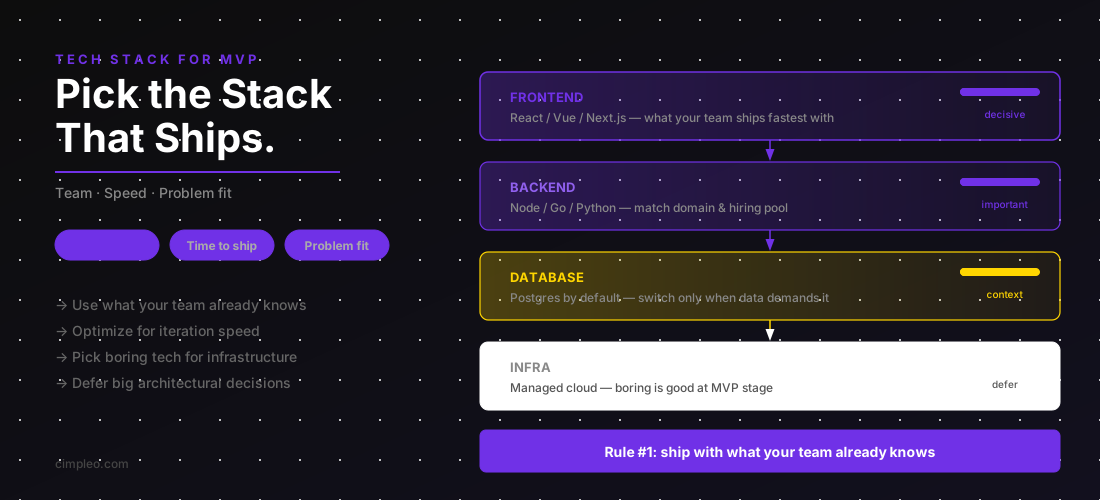
At some point in every early-stage project, someone asks: “What tech stack should we use?” The question sounds pragmatic. It usually isn’t. Most of the time it’s a disguised version of a different question: “What’s the best stack out there?” And that’s the wrong question entirely.
There is no best stack. There is only the right stack for your team, your timeline, your hiring situation, and the nature of the problem you’re solving. Everything else is noise.
The Question Everyone Asks Wrong
Type “best tech stack for startup” into any forum and you’ll get 40 passionate answers, each contradicting the last. Rails vs Django vs Next.js vs Remix. PostgreSQL vs MongoDB. Monolith vs microservices.
These debates are mostly useless at MVP stage. The stack that wins is the one your team ships confidently and quickly — not the one that wins Twitter arguments.
The right framing isn’t “what’s the best stack.” It’s “what stack minimises our time from idea to deployed, working software, given these specific constraints?”
The Three Variables That Actually Matter
1. Team Familiarity
This one is decisive and it is consistently underweighted. A team that knows Rails deeply will build a better MVP faster in Rails than a team that half-knows Node. The productivity gap between “know it well” and “learning it” is enormous at the beginning of a project when you’re also figuring out the product, the domain, and the users simultaneously.
If your team has shipped production systems in a technology, that technology has a massive advantage over everything else on this list.
2. Hiring Pool
Your MVP becomes a V1 becomes a product with a team around it. The stack you pick in week one is the stack your first three engineering hires will need to work in. Picking a framework that has 50 developers in your market doesn’t just create a future hiring problem — it creates a current one, because you’re building toward a team that will be hard to grow.
React, TypeScript, Python, PostgreSQL — these have enormous hiring pools. Framework-of-the-month options often don’t.
3. Problem Domain Fit
Some stacks fit certain problem types naturally. Real-time systems have different requirements than batch-processing pipelines. Mobile apps are different from browser tools. IoT firmware is different from API-heavy SaaS. At MVP stage you won’t have the load to expose performance differences. The question is whether the ecosystem around a stack has the libraries, patterns, and examples relevant to your problem.
Where Framework Debates Waste Your Time
At MVP stage, the difference between React and Vue is irrelevant. The difference between FastAPI and Flask is irrelevant. The difference between Tailwind and Bootstrap is irrelevant.
These debates consume real energy that should be going toward shipping. If your team is spending more than an afternoon on frontend framework selection, something has gone wrong. Pick the one your best frontend engineer knows best. Move on.
The same goes for deployment platform, CI tooling, and component library choices. Default to what your team uses. There is no decision here that can’t be changed later, and the cost of changing is much lower than the cost of extended pre-build analysis.
The Stack Decisions That DO Matter
Two decisions have genuine downstream consequences that are harder to undo:
SQL vs NoSQL
This is worth thinking about carefully — not because one is better, but because the data model you pick at the start tends to persist. Relational databases (PostgreSQL, MySQL) give you joins, transactions, and strong consistency. They’re appropriate for most business applications: user accounts, orders, invoices, anything where relationships between entities matter.
Document databases (MongoDB, Firestore) make sense when your data is genuinely document-shaped and schema varies significantly between records. They’re often chosen for the wrong reasons (perceived speed or flexibility) and cause pain later when you need query patterns that relational databases handle naturally.
Default to PostgreSQL unless you have a specific reason not to.
Monolith vs Serverless/Microservices
For an MVP, start with a monolith. The people who built Shopify, GitHub, and Basecamp all say the same thing looking back. A monolith is simpler to develop, simpler to debug, simpler to deploy, and simpler to change.
Microservices and serverless architectures introduce operational complexity (distributed tracing, network failure modes, cross-service contracts) that is hard to manage even with experienced teams. At MVP stage, you don’t have the scale problems that microservices solve. You have speed problems. A monolith solves speed problems.
A Decision Matrix
| Signal | Recommendation |
|---|---|
| Team has production experience with framework X | Use framework X |
| Greenfield, team split on options | Pick the option with the largest hiring pool |
| Real-time features (chat, notifications) | Node.js or Go back-end; weigh this against team familiarity |
| Data-heavy, relational entities | PostgreSQL as default |
| Flexible schema, document-shaped data | MongoDB — only if schema genuinely varies |
| Needs to grow to a team quickly | TypeScript, Python, or Go — wide talent pools |
| MVP needs to ship in under 6 weeks | Maximise team familiarity over all other factors |
| Long-term product, not throwaway | Monolith to start; split later if clear boundaries emerge |
Common Mistakes
Choosing for your CV. “I’ve always wanted to learn Rust” is a valid personal goal. It is not a valid reason to build a client’s MVP in Rust. The MVP isn’t a learning project — it’s a product with a user on the other end.
Choosing for hype. A new framework that just hit 10k GitHub stars may be genuinely good. It also has minimal production battle-testing, a small community, and limited Stack Overflow coverage. These matter when you hit an obscure bug at 11pm before a launch.
Over-engineering for scale you don’t have. You don’t need Redis caching for a user base of 200. You don’t need a Kubernetes cluster for traffic that a single VPS could handle with room to spare. Every piece of infrastructure you add is something you need to maintain, monitor, and debug. Complexity is a cost.
Reacting to theoretical future problems. “But what if we get 10 million users?” You won’t — not yet. And if you do, you’ll have the resources to fix infrastructure problems then. The companies that scale successfully almost universally started simpler than they thought they needed to.
What to Optimise For at MVP Stage
Three things, in this order:
Speed to production. The faster you ship, the faster you learn whether you’re building the right thing. Every week of pre-build analysis is a week where your assumptions go untested.
Debuggability. Things will break. Choose a stack where broken things are easy to find and fix — good error messages, mature logging tooling, a large community that’s seen your problem before.
Team confidence. A team that’s comfortable with their tools moves faster, writes cleaner code, and catches problems earlier. Confidence isn’t about familiarity only — it’s also about using tools that have good documentation, sensible defaults, and clear conventions.
If you’re optimising for these three things, the stack question largely answers itself: use what your team knows, default to boring technology choices with large communities, and avoid novelty for its own sake.
The best MVP stack is the one that ships.
Building an MVP and not sure where to start? CimpleO’s MVP development team scopes the stack alongside the product, then builds it. Write to us at hello@cimpleo.com to get started.